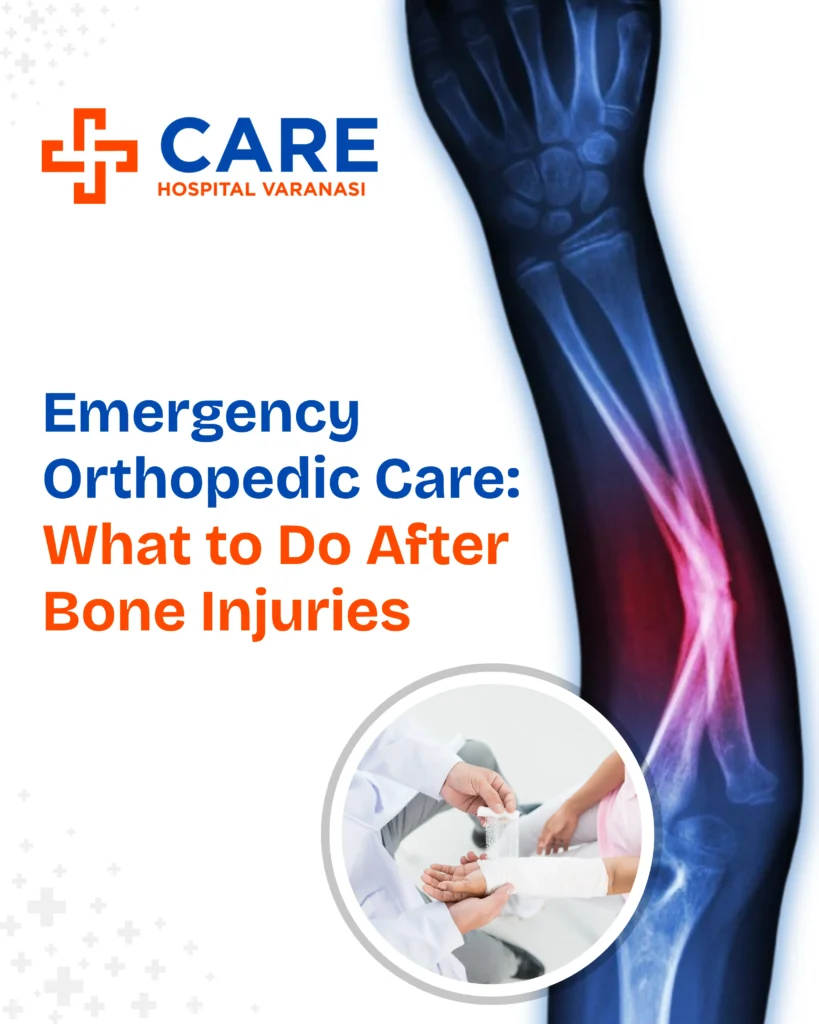
Bone injuries, from simple fractures to complex breaks, can happen suddenly—whether from a fall on slippery roads during monsoon season, a sports mishap, a road accident, or even a slip at home. In moments like these, panic often sets in, but knowing the right immediate steps can make a huge difference in recovery, reduce complications, and prevent further damage.
Emergency orthopedic care focuses on stabilizing the injury, managing pain and swelling, and getting professional help quickly. While most bone injuries heal well with proper treatment, delays or incorrect handling can lead to prolonged pain, infection, misalignment, or permanent issues.
In Varanasi and nearby areas like Prayagraj, quick access to expert care is essential. At Care Hospital Varanasi, recognized as one of the best hospitals in Varanasi, our Orthopedic Surgery in Varanasi department provides round-the-clock emergency services for trauma, fractures, and musculoskeletal injuries. Led by experienced orthopedic surgeons, we handle everything from initial stabilization to advanced surgical repairs. This comprehensive guide walks you through what to do right after a bone injury, step by step, so you can act confidently while seeking medical help.
Understanding Bone Injuries: Types and Why They Happen
A bone injury, or fracture, occurs when force exceeds the bone’s strength. Bones are strong but not unbreakable—impacts from falls, twists, or direct blows can crack or shatter them.
Common types include:
- Closed (simple) fracture: Bone breaks but skin remains intact.
- Open (compound) fracture: Bone pierces the skin, increasing infection risk.
- Stable fracture: Broken ends align reasonably well.
- Displaced fracture: Ends are out of place, often needing realignment.
- Comminuted fracture: Bone shatters into multiple pieces.
- Stress fracture: Tiny cracks from repetitive force (common in runners or those with sudden activity increases).
- Greenstick fracture: Partial break, more common in children.
Related injuries include dislocations (joint displacement) and severe sprains (ligament tears that mimic fractures).
Causes in daily life: Road accidents (common in Uttar Pradesh traffic), falls from heights or stairs, sports (cricket, football), workplace mishaps, or osteoporosis-related breaks in older adults.
Signs of a possible bone injury:
- Intense pain, especially with movement or touch.
- Swelling and bruising.
- Deformity (limb looks bent or shortened).
- Inability to bear weight or move the area.
- Numbness, tingling, or pale/cold skin beyond the injury (possible nerve/vessel damage).
- Bone visible through skin (emergency).
- Grating sensation or sound when moving.
If you see these, treat it as serious and act fast.
Immediate First Aid: The Critical First Minutes
The goal is to prevent worsening, control bleeding, reduce swelling, and stabilize until professional help arrives.
Step 1: Ensure Safety and Assess the Situation
- Make sure the scene is safe (e.g., move away from traffic if on road).
- Check if the person is conscious, breathing, and responsive.
- If unconscious or not breathing, call emergency services immediately and start CPR if trained.
- Stay calm—your composure helps the injured person.
Step 2: Call for Emergency Help
In India, dial 108 or 102 for ambulance services, or rush to the nearest hospital with orthopedic facilities. Provide details: location, injury description, number of people affected, and any bleeding or unconsciousness.
Do not delay—time is critical for open fractures or vascular compromise.
Step 3: Control Bleeding (Especially for Open Fractures)
- If bone protrudes or there’s heavy bleeding, apply firm pressure with a clean cloth, sterile bandage, or clothing.
- Do not push bone back in—this risks infection and further damage.
- Elevate the limb if possible without causing more pain.
- Cover the wound loosely to protect from dirt.
Step 4: Immobilize the Injured Area
- Prevent movement—key to avoiding further damage to bones, vessels, nerves.
- Use makeshift splints: rolled newspapers, boards, pillows, or clothing to support above and below the injury.
- For arms: Use a sling from a scarf or shirt.
- For legs: Tie legs together gently or use a board.
- Do not try to straighten or realign the bone unless trained and necessary (e.g., severe angulation blocking circulation).
- If it’s a suspected neck/back injury, do not move the person—keep head/neck in line.
Step 5: Apply the RICE Method (Adapted for Suspected Fractures)
RICE (Rest, Ice, Compression, Elevation) helps manage pain and swelling in soft-tissue injuries and supports fracture care.
- Rest: Stop all activity; keep weight off the area.
- Ice: Wrap ice or cold pack in cloth; apply 15–20 minutes every 2–3 hours. Avoid direct skin contact to prevent frostbite.
- Compression: Lightly wrap with elastic bandage if no open wound—snug but not tight (check circulation).
- Elevation: Raise above heart level to reduce swelling (use pillows).
For fractures, focus on immobilization first—RICE complements it.
Step 6: Manage Pain and Shock
- Give pain relief if available (paracetamol; avoid aspirin if bleeding).
- Treat shock: Lay person flat, elevate legs slightly (unless spine injury suspected), keep warm with blanket.
- Reassure the person—calmness reduces stress.
What NOT to Do
- Don’t give food/drink (surgery may be needed).
- Don’t apply heat initially (increases swelling).
- Don’t massage or manipulate the area.
- Don’t remove clothing if it sticks to wound.
- Don’t ignore numbness, pale skin, or severe pain—these signal compartment syndrome or vascular issues.
When to Rush to the Emergency Room
Seek immediate care if:
- Open fracture (bone through skin).
- Heavy bleeding or shock signs.
- Deformity or limb looks unnatural.
- Numbness, tingling, or cold/pale extremity.
- Suspected head, neck, spine, or multiple injuries.
- Inability to move limb or bear weight.
- Severe pain unrelieved by rest.
For less severe cases (e.g., possible stress fracture), see an orthopedic specialist soon.
What Happens in the Hospital: From ER to Treatment
In the ER:
- Assessment: Vitals, history, exam.
- Imaging: X-rays (primary), CT/MRI for complex cases.
- Pain control: Medications, nerve blocks.
- Stabilization: Splint/cast, reduction (realignment) if needed.
- Antibiotics/tetanus for open fractures.
- Surgery planning if required.
Treatment options:
- Non-surgical: Casting, bracing, traction for stable fractures.
- Surgical: Open reduction internal fixation (plates/screws), external fixation, or intramedullary nailing for unstable/comminuted breaks.
Recovery varies: 6–8 weeks for simple breaks; longer for complex ones with rehab.
Rehabilitation and Long-Term Recovery
After initial care:
- Follow-up with orthopedic specialist.
- Physical therapy: Restore strength, mobility.
- Nutrition: Calcium, vitamin D, protein for healing.
- Avoid smoking (delays bone healing).
- Gradual return to activity.
Complications to watch: Infection, non-union, malunion, arthritis.
Prevention Tips for Bone Injuries
- Wear seatbelts/helmets.
- Use proper lifting techniques.
- Strengthen bones with weight-bearing exercise.
- Balance diet with calcium/vitamin D.
- Fall-proof home (remove rugs, good lighting).
- Manage osteoporosis if at risk.
Why Care Hospital Varanasi for Emergency Orthopedic Care?
As the best hospital in Varanasi, Care Hospital offers 24/7 emergency services with dedicated trauma care. Our Orthopedic Surgery in Varanasi team handles fractures, dislocations, and complex trauma using modern techniques like minimally invasive fixation and advanced imaging for better outcomes. Multispecialty support ensures comprehensive recovery.
Bone injuries require prompt, expert care—don’t wait if symptoms persist. This guide is informational; always consult professionals.
If you or someone experiences a bone injury, head to Care Hospital Varanasi for immediate, reliable treatment.