A stroke doesn’t wait. It strikes suddenly, often without warning, and every single minute that passes without treatment can mean the difference between full recovery and lifelong disability—or even life and death. The medical community has long used the phrase “time is brain” to drive home this urgent reality. In simple terms: the longer the brain is deprived of blood and oxygen, the more irreversible damage occurs.
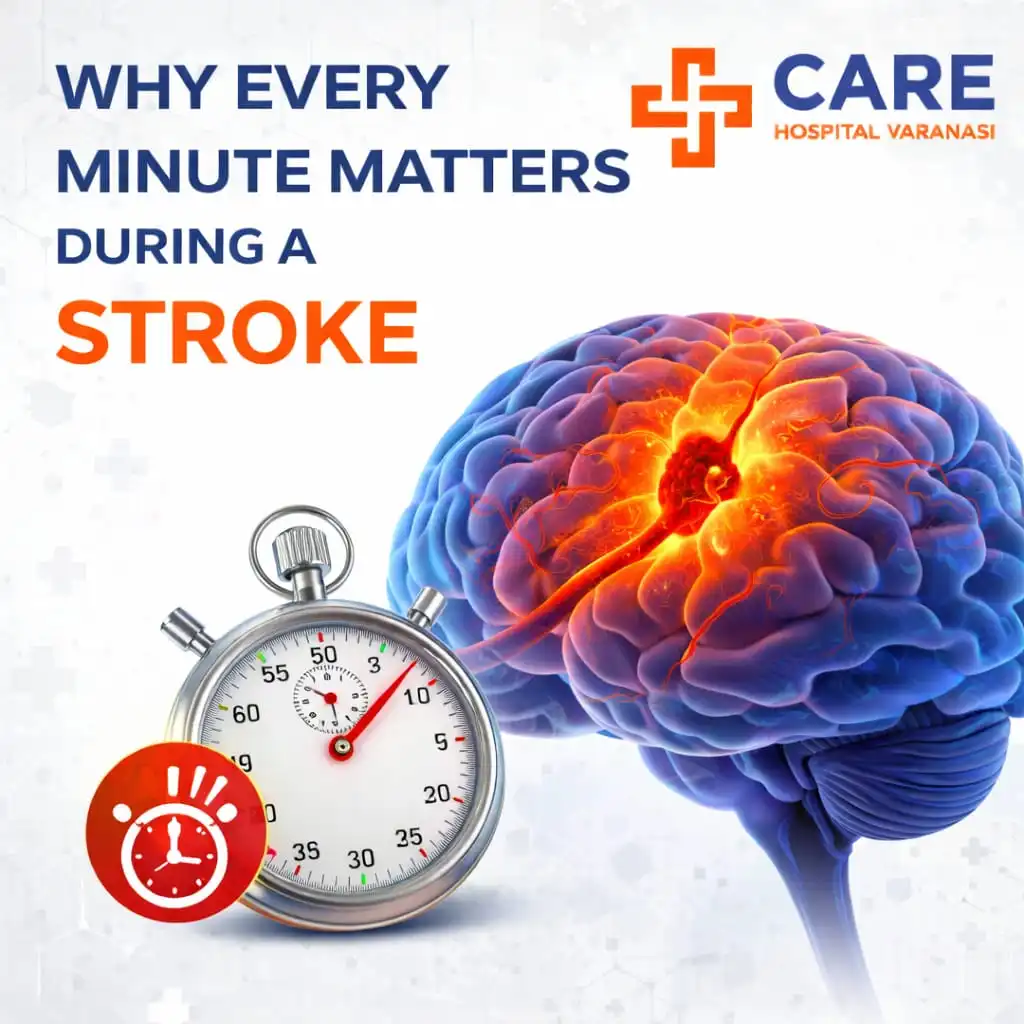
In ischemic strokes (the most common type, about 87% of cases), a blockage stops blood flow to part of the brain. Brain cells begin dying within minutes. Studies show that, on average, 1.9 million neurons—the fundamental building blocks of the brain—are lost every minute the stroke goes untreated. That’s alongside billions of synapses and miles of nerve fibers. These numbers aren’t just statistics; they represent memories, movement, speech, and independence slipping away.
This article explains in depth why every minute matters during a stroke, covering the science of brain cell loss, treatment time windows, symptoms to recognize instantly, risk factors, prevention, and what to do if a stroke happens. If you’re in Varanasi or nearby, quick access to advanced care can dramatically change outcomes—more on that later.
The Science Behind “Time Is Brain”
The human brain is incredibly demanding. It uses about 20% of the body’s oxygen and energy despite making up only 2% of body weight. When blood flow stops—even partially—brain tissue starts a rapid cascade of damage.
In a typical large-vessel ischemic stroke:
- Within seconds: Neurons sense low oxygen and switch to inefficient energy production.
- Within minutes: Cell membranes fail, causing swelling (cytotoxic edema).
- By 4–6 minutes of severe ischemia: Irreversible cell death begins in the core infarct area.
- Surrounding tissue (the penumbra) remains salvageable but shrinks as time passes.
A landmark 2006 study quantified this loss: in untreated large-vessel strokes, the average patient loses 1.9 million neurons, 14 billion synapses, and 12 km (7.5 miles) of myelinated fibers per minute. Over an hour, that’s roughly 120 million neurons—equivalent to accelerating normal brain aging dramatically.
Individual variation exists—some people with good collateral circulation lose tissue slower—but the average holds true. Delaying treatment accelerates permanent harm. Modern imaging (like perfusion CT or MRI) confirms that faster reperfusion preserves more brain tissue and improves functional outcomes.
This is why stroke systems worldwide prioritize rapid response: every minute saved translates to fewer disabilities and better quality of life.
Types of Stroke and Why Time Sensitivity Varies
Ischemic Stroke (Blockage)
Most strokes are ischemic, caused by clots or plaque blocking arteries. Here, time is brain is most dramatic. Treatments aim to restore flow quickly.
- Intravenous thrombolysis (tPA/alteplase): Dissolves clots. Standard window is up to 4.5 hours from symptom onset, with best results in the first 90–180 minutes.
- Mechanical thrombectomy: Physically removes clots. Originally limited to 6 hours, now extended to 24 hours (or beyond in select cases) for patients with favorable imaging (e.g., large mismatch between infarct core and salvageable penumbra per DAWN/DEFUSE-3 trials).
Even in extended windows, earlier is better—outcomes drop sharply with delays.
Hemorrhagic Stroke (Bleed)
About 13% of strokes involve vessel rupture, causing bleeding into or around the brain. Time matters differently: rapid control of blood pressure and possible surgical intervention prevent hematoma expansion and pressure buildup. Delays increase mortality risk.
Transient Ischemic Attack (TIA or “Mini-Stroke”)
Symptoms resolve quickly, but TIA signals high risk—up to 10–20% have a full stroke within 90 days, often in the first 48 hours. Treat TIAs as emergencies to prevent the real event.
Recognizing Stroke Symptoms: Act FAST
Use the FAST acronym to spot signs instantly:
- Face drooping: Smile—does one side sag?
- Arm weakness: Raise both arms—does one drift down?
- Speech difficulty: Slurred words or confusion?
- Time to call emergency services: Even if symptoms fade.
Other signs: sudden numbness (one side), vision loss, severe headache, dizziness, or balance issues.
In India, awareness remains low, contributing to delays. Public campaigns stress: don’t wait, don’t drive yourself—call for help immediately.
The Golden Hour and Treatment Windows
The first 60 minutes after onset are critical—the “golden hour.” Arriving at a hospital quickly allows:
- Rapid imaging (CT/MRI).
- Thrombolysis if eligible (door-to-needle time ideally <60 minutes).
- Thrombectomy assessment.
Current guidelines (AHA/ASA and recent updates):
- IV tPA: Up to 4.5 hours (strongest benefit <3 hours).
- Thrombectomy: Up to 6–24 hours with imaging selection showing salvageable tissue.
Delays beyond these windows limit options, worsening prognosis. In resource-limited areas, transport time adds urgency—pre-hospital systems (ambulance routing to stroke centers) save lives.
Stroke Statistics in India: A Growing Crisis
Stroke is India’s second-leading cause of death and major disability source. Recent Global Burden of Disease data (up to 2021, with trends continuing) show:
- Rising incidence, especially in younger adults.
- High burden in lower-middle-income countries like India (87% of global stroke deaths).
- Many cases linked to hypertension, diabetes, smoking, and poor lifestyle.
Mortality and disability are higher due to delayed care. Early intervention could prevent much of this—emphasizing why every minute counts locally too.
Risk Factors: What Increases Your Vulnerability
Controllable risks:
- High blood pressure (top factor).
- Diabetes, high cholesterol, smoking, obesity.
- Atrial fibrillation (clot source).
Non-controllable: Age (>55), family history, prior stroke/TIA.
Managing these slashes risk—regular check-ups, medication adherence, healthy diet, exercise.
Prevention: Stop the Clock Before It Starts
Primary prevention:
- Control BP (<130/80 mmHg).
- Manage diabetes/cholesterol.
- Quit smoking, limit alcohol.
- Heart-healthy diet (Mediterranean-style).
- Regular physical activity.
Secondary prevention (post-TIA/stroke): Antiplatelets/anticoagulants, carotid procedures if needed.
Lifestyle changes prevent many strokes—knowledge empowers action.
What to Do If You Suspect a Stroke
- Recognize symptoms using FAST.
- Call emergency services immediately—note exact onset time.
- Don’t give food, drink, or aspirin (unless advised).
- Note symptoms’ start and changes.
In Varanasi, prompt care at a facility with stroke expertise improves chances. For comprehensive neurological emergencies or related urological issues (e.g., post-stroke urinary complications), specialized departments help. The best hospital in Varanasi offers 24/7 stroke protocols, advanced imaging, thrombolysis, and thrombectomy capabilities. For associated concerns like urinary retention or infections after stroke, expert urology hospital in Varanasi services provide integrated care.
Long-Term Impact: Why Saving Minutes Saves Lives
Faster treatment means:
- Smaller infarcts.
- Better functional recovery (walking, speaking, independence).
- Lower healthcare costs and societal burden.
Rehabilitation follows, but prevention and speed limit damage.
Conclusion: Make Every Minute Count
A stroke is a race against time. Every minute matters during a stroke because brain tissue dies rapidly without blood flow. Recognizing symptoms, acting FAST, and reaching expert care quickly transforms outcomes—from devastating disability to meaningful recovery.
Spread awareness, control risks, and prioritize health. If symptoms appear, seconds count—act now. In places like Varanasi, trusted centers stand ready to help—your quick response could save a life, perhaps your own or a loved one’s.